
The Future of Paper Machine Clothing: Why Specialized AI Matters
- Snehes Dasgupta

- Jun 25
- 13 min read
Updated: Jun 26
1. Artificial Intelligence Has Changed the Way We Work
The rapid advancement of Artificial Intelligence (AI) since 2023 has transformed the way people work, learn, and solve problems. What began as a technology capable of generating text has quickly evolved into a practical assistant used across engineering, healthcare, finance, software development, education, legal services, manufacturing, and scientific research.
Today, AI is helping professionals summarize large volumes of information, generate technical documents, analyze complex data, write software code, assist medical diagnosis, optimize manufacturing processes, and accelerate research. Instead of replacing human expertise, AI is increasingly becoming a productivity tool—allowing experienced professionals to make better decisions in less time.
This shift represents one of the most significant technological changes since the arrival of the Internet. Organizations across the world are now exploring how AI can improve efficiency, reduce repetitive work, preserve knowledge, and support faster technical decision-making.
However, as AI adoption has matured, an important realization has emerged.
General-purpose AI is extremely powerful, but every industry has its own terminology, operating practices, engineering principles, and decision-making processes. The questions asked by a doctor differ greatly from those asked by a lawyer. Likewise, the information required by a software engineer is entirely different from that needed by a paper machine superintendent or a Paper Machine Clothing (PMC) specialist.
This realization is driving the next evolution of Artificial Intelligence—not simply bigger AI models, but specialized AI systems designed for specific industries and professional domains.
Instead of trying to know everything, these systems focus on understanding one field exceptionally well.
Just as organizations invest in specialists rather than generalists for complex technical challenges, AI is following the same direction.
The future of industrial AI is not merely about answering questions.
It is about understanding context, asking better questions, organizing technical knowledge, and supporting better engineering decisions.
2. The Next Evolution: Specialized AI for Industrial Expertise:
Across many industries, specialized AI is already beginning to complement professional expertise.
In healthcare, AI systems assist radiologists by highlighting abnormalities in medical images before a final diagnosis is made by the physician. In software engineering, AI helps developers review code, identify potential errors, and suggest improvements. In legal practice, AI accelerates document review and contract analysis, allowing lawyers to focus on interpretation and strategy rather than repetitive reading.
These examples demonstrate an important principle.
The greatest value of AI does not come from replacing professionals.
It comes from supporting professionals with structured knowledge, faster analysis, and better organization of information.
The paper industry is also embracing Artificial Intelligence, although primarily in machine automation and process optimization.
Modern paper mills increasingly use AI and machine learning for predictive maintenance, process control, defect detection through vision systems, quality prediction, energy optimization, and production planning. These technologies help improve operational efficiency by continuously analyzing large volumes of process data generated by paper machines.
Yet one important area has received comparatively little attention.
Technical troubleshooting and decision support for Paper Machine Clothing.
PMC-related issues are rarely isolated problems. A drainage issue may originate from furnish changes, forming fabric design, contamination, machine settings, vacuum conditions, cleaning efficiency, or operational practices. A reduction in press solids may be influenced by felt condition, nip loading, fabric permeability, shower performance, or press configuration. Similarly, dryer-related problems often involve interactions between press performance, ventilation, condensate removal, fabric characteristics, and machine operation.
These challenges cannot usually be solved by looking at a single parameter.
They require structured technical thinking, systematic investigation, and an understanding of how multiple factors interact throughout the paper machine.
This is where specialized AI has the potential to create significant value.
Rather than functioning as a general information tool, a specialized AI can guide engineers through a logical troubleshooting process, identify missing information, organize observations, narrow possible causes, and support more informed technical decisions.
For highly specialized engineering disciplines such as Paper Machine Clothing, the future of AI is not about replacing human expertise.
It is about making that expertise more accessible, more structured, and available whenever technical support is needed.
3. Why Paper Machine Clothing Remains One of the Most Challenging Areas in Paper making
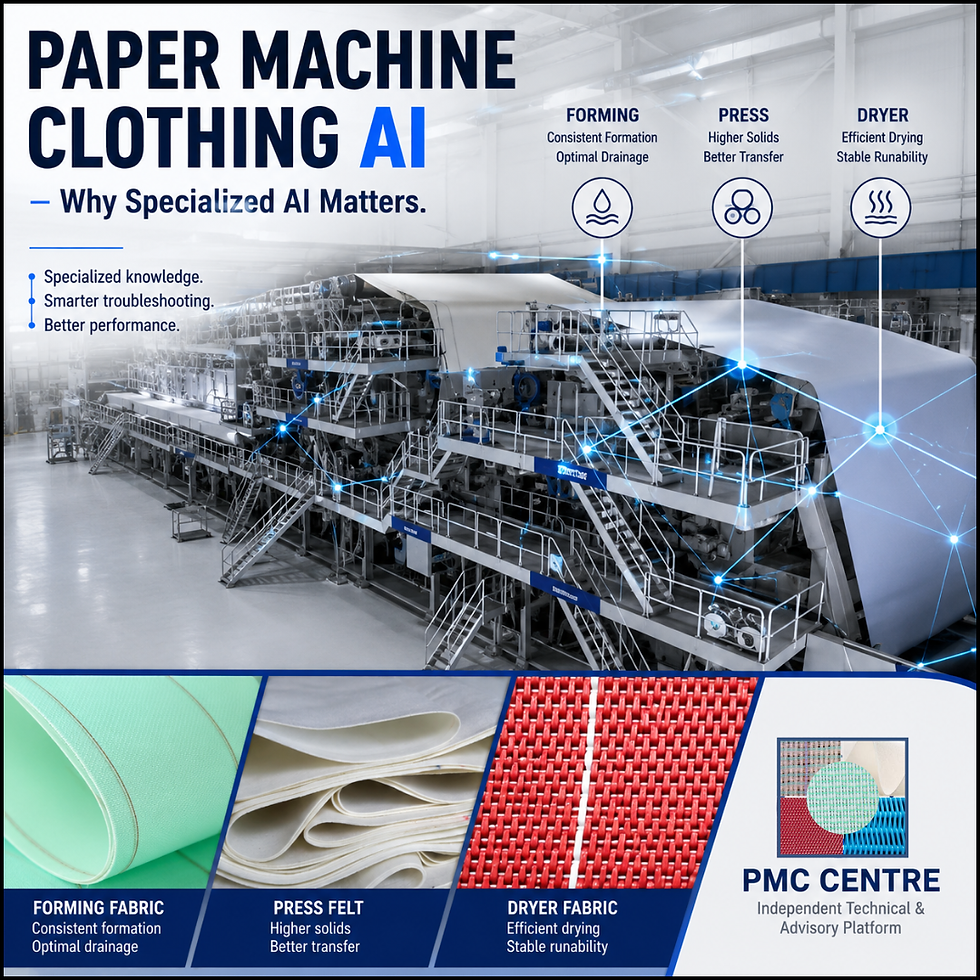
Paper Machine Clothing (PMC) is often described as the "heart" of the paper machine. Forming fabrics, press felts, and dryer fabrics directly influence drainage, sheet formation, water removal, moisture profile, energy consumption, machine speed, paper quality, and ultimately the cost per tonne of production.
Yet, despite its critical role, PMC remains one of the most complex engineering disciplines in the paper industry.
Unlike many machine components, PMC performance is not determined by the fabric alone. It is the result of continuous interaction between the machine, furnish, paper grade, wet-end chemistry, operating conditions, cleaning systems, maintenance practices, and the experience of the operating team.
A forming fabric that performs exceptionally well on one machine may produce disappointing results on another machine running a similar grade. Likewise, a press felt with excellent laboratory properties may behave differently under changing nip loads, contamination levels, or furnish conditions. Dryer fabrics, although often considered simple conveying elements, can significantly influence moisture profile, runnability, ventilation efficiency, and drying stability.
This complexity explains why PMC troubleshooting is rarely straightforward.
When a machine experiences poor drainage, excessive steam consumption, premature fabric wear, edge curl, moisture profile variation, or sheet quality problems, the visible symptom is often only the final outcome of several interacting factors. Changing the fabric alone may not solve the problem if the root cause lies in machine settings, vacuum balance, contamination, cleaning efficiency, chemistry, or operating practices.
Successful troubleshooting therefore requires more than product knowledge.
It requires a structured understanding of the entire papermaking system and the ability to evaluate how multiple variables influence each other before drawing conclusions.
This systems approach is what makes PMC engineering both challenging and fascinating—and why effective technical support remains difficult to obtain.
4. The Knowledge Gap: Why the Industry Needs an Independent Technical Platform

When paper makers face a Paper Machine Clothing problem, their first source of support is usually the fabric supplier.
This is both natural and valuable.
PMC manufacturers possess deep expertise in the design, construction, and application of their own products. Their technical teams provide essential assistance during fabric selection, installation, start-up, and performance evaluation.
However, modern papermaking has become increasingly complex.
A drainage problem may originate from furnish changes rather than fabric design. Increased steam consumption may result from press performance rather than dryer fabrics. Premature wear may be caused by machine alignment, cleaning practices, or operating conditions rather than the fabric itself.
In many cases, the actual root cause extends beyond the scope of any single product or supplier.
A similar challenge exists for PMC manufacturers.
Although manufacturers receive valuable operational feedback from paper mills, that information is often limited to specific machines, products, or customer experiences. Developing new fabric designs therefore depends on field observations, technical expertise, laboratory testing, and continuous trial-and-learning across many different operating environments.
What has largely been missing is a neutral technical platform where knowledge can be organized independently of any individual manufacturer or paper mill.
A platform that looks beyond individual products.
A platform that focuses on understanding the complete interaction between the paper machine and Paper Machine Clothing.
A platform that supports both paper makers and PMC manufacturers through structured technical knowledge, independent evaluation, and systematic troubleshooting.
This is the gap that inspired the creation of PMC CENTRE.
The objective was never to replace existing technical support provided by manufacturers.
Rather, it was to complement the industry's existing knowledge by providing an independent technical perspective focused exclusively on Paper Machine Clothing.
By bringing together decades of practical experience, structured technical content, and now specialized AI-assisted analysis, PMC CENTRE is being developed as a long-term knowledge and advisory platform dedicated to improving Paper Machine Clothing performance across the global paper industry.
5. Introducing PMC CENTRE AI – Extending Independent Technical Expertise into the Digital Age:
As Paper Machine Clothing technology became more complex and paper machines continued to operate at higher speeds with increasingly demanding product requirements, one question became increasingly important:
How can independent PMC knowledge be made available to more professionals, whenever they need it?
Traditionally, technical support has depended on the availability of experienced specialists. While this approach remains invaluable, access is often limited by time zones, geographical distance, and the availability of experts.
At the same time, a new generation of engineers expects technical information to be available instantly, while experienced professionals increasingly seek structured tools that help organize investigations rather than simply providing isolated answers.
These changing industry needs led to the development of PMC CENTRE AI.
PMC CENTRE AI is the digital extension of PMC CENTRE's independent technical and advisory platform. Rather than replacing human expertise, it has been designed to make structured PMC knowledge more accessible, helping paper makers and PMC professionals investigate problems in a systematic and logical manner.
Unlike general-purpose AI systems, PMC CENTRE AI has been developed exclusively for the Paper Machine Clothing domain. Its objective is not merely to answer technical questions, but to guide users through a structured troubleshooting process by identifying missing information, asking relevant follow-up questions, and helping narrow down possible causes.
This approach reflects the same methodology followed by experienced PMC consultants.
Before recommending solutions, an experienced engineer first seeks to understand the operating conditions, machine configuration, furnish characteristics, process history, and performance changes. Good troubleshooting begins with asking the right questions—not by making assumptions.
PMC CENTRE AI has been developed around this philosophy.
Its purpose is to assist technical thinking, encourage systematic investigation, and help users reach better-informed decisions while remaining independent of any particular product or manufacturer.
It represents another important step towards PMC CENTRE's long-term objective of creating the world's leading independent technical knowledge and advisory platform dedicated exclusively to Paper Machine Clothing.
6. More Than an AI – A Structured Technical Assistant for the PMC Industry:

Although Artificial Intelligence has become widely available, most AI systems are designed as general conversational assistants. They possess broad knowledge across thousands of subjects but are not specifically trained to think like a Paper Machine Clothing specialist.
PMC troubleshooting requires a different approach.
A drainage problem cannot be evaluated without considering furnish characteristics, fabric design, machine geometry, vacuum levels, cleaning efficiency, operating conditions, and historical machine performance. Similarly, excessive steam consumption may involve interactions between the forming section, press section, dryer section, ventilation system, condensate removal, and PMC condition.
These relationships make PMC troubleshooting a process of technical investigation rather than simple question-and-answer.
PMC CENTRE AI has therefore been designed as a structured technical assistant, supporting users throughout the troubleshooting process.
Its capabilities include:
Guiding users through logical troubleshooting steps rather than providing isolated answers.
Asking relevant follow-up questions to collect essential technical information.
Assisting both paper makers and PMC manufacturers with forming fabrics, press felts, and dryer fabrics.
Explaining technical concepts in a structured and practical manner.
Providing independent guidance focused on machine performance rather than promoting specific products.
Combining technical knowledge with continuously expanding digital resources to support informed decision-making.
The system is also intended to support continuous technical learning.
Engineers who are new to Paper Machine Clothing—whether they come from textile engineering, mechanical engineering, electrical engineering, electronics, or papermaking—often encounter practical questions that are difficult to answer through conventional documentation or day-to-day experience.
PMC technology is highly specialized, and much of its practical knowledge has traditionally been acquired through years of field experience and trial-and-error. Much of the practical knowledge in Paper Machine Clothing still resides in the experience of individuals rather than in structured, easily accessible technical resources. Preserving and making that knowledge more accessible is one of the long-term objectives of PMC CENTRE AI.
By encouraging structured questioning and explaining technical concepts in context, PMC CENTRE AI serves as an on-demand technical learning companion. It helps professionals build confidence, deepen their understanding of PMC technology, and make better-informed engineering decisions throughout their careers.
This learning support is equally valuable for experienced paper makers who need a better understanding of forming fabrics, press felts, and dryer fabrics, as well as for PMC professionals seeking to understand how machine conditions influence fabric performance.
Importantly, PMC CENTRE AI should not be viewed as an automated expert replacing human judgement.
Instead, it functions as a technical partner—helping users think more systematically, organize available information, identify missing data, and approach complex PMC problems with greater confidence.
This distinction is fundamental.
The true value of PMC CENTRE AI lies not in providing instant answers, but in helping users ask better questions, analyse technical situations more effectively, and make more informed engineering decisions.
7. Early Industry Response – Learning from Real Technical Users:
Any technical platform ultimately proves its value not through claims, but through practical use.
Since its initial public release, PMC CENTRE AI has been used by paper makers, PMC professionals, consultants, and engineers from different parts of the world to explore technical questions, investigate machine clothing issues, and support troubleshooting activities.
One of the most encouraging aspects of this early adoption has been the quality of user feedback.
Rather than focusing on the speed of responses, several users have highlighted the structured approach taken by the system during technical investigations. In particular, users appreciated that the AI did not immediately jump to conclusions but instead asked relevant follow-up questions to better understand the operating conditions before suggesting possible causes.
This reflects the fundamental philosophy behind PMC CENTRE AI.
Experienced PMC engineers know that successful troubleshooting rarely begins with an answer. It begins with gathering the right information. Small changes in furnish, machine speed, vacuum levels, cleaning conditions, fabric age, or operating practices can completely alter the direction of an investigation.
By encouraging users to think systematically, PMC CENTRE AI helps transform troubleshooting from a process of guesswork into a process of structured technical evaluation.
This approach has also received positive feedback through PMC CENTRE's independent consultancy activities. Clients have consistently appreciated the neutral, system-level perspective provided by PMC CENTRE when evaluating Paper Machine Clothing performance.
The combination of independent consultancy and AI-assisted technical support creates an important advantage.
Each complements the other.
Practical field experience strengthens the knowledge behind the platform, while the AI helps make that structured thinking more widely accessible to the global PMC community.
As more professionals use PMC CENTRE AI and provide constructive feedback, the platform will continue to evolve—expanding its knowledge base, refining its troubleshooting methodology, and supporting increasingly sophisticated technical discussions.
The journey has only begun, but the early response indicates that there is genuine industry interest in a specialized AI developed exclusively for Paper Machine Clothing.
8. AI Will Not Replace Human Expertise—It Will Enhance It
One question frequently raised whenever Artificial Intelligence is discussed is whether AI will eventually replace experienced engineers and technical specialists.
In the field of Paper Machine Clothing, the answer is clear.
No.
Papermaking is a highly dynamic process where machine behaviour, operating practices, furnish quality, environmental conditions, maintenance history, and human judgement all influence performance. Every paper machine develops its own operating characteristics over time, and experienced engineers often recognize subtle patterns that cannot be fully captured by data alone.
No AI system can replace decades of practical mill experience, plant observations, customer interactions, and engineering intuition.
Nor should it try.
The purpose of PMC CENTRE AI is fundamentally different.
It has been designed to assist—not replace—technical professionals.
It helps organize information, supports logical troubleshooting, explains technical concepts, and encourages systematic investigation. It acts as a technical companion that complements human expertise by making structured knowledge available whenever it is needed.
This relationship is similar to the way modern engineering software supports design engineers. Simulation software does not replace engineering judgement; it provides additional insight that enables engineers to make better decisions. Likewise, predictive maintenance systems do not replace maintenance teams—they provide information that helps those teams act more effectively.
PMC CENTRE AI follows the same philosophy.
For routine technical questions, learning, and preliminary troubleshooting, it provides immediate structured guidance. For complex investigations, unusual machine behaviour, product development, or strategic technical decisions, experienced PMC specialists remain indispensable.
This is why PMC CENTRE AI should be viewed as an extension of PMC CENTRE's consultancy rather than an alternative to it.
Together, they combine the strengths of human experience with the speed, consistency, and accessibility of modern Artificial Intelligence.
The future of engineering will not be built on humans competing with AI.
It will be built on experienced professionals and specialized AI working together to solve increasingly complex industrial challenges.

9. Looking Ahead – Building the Future of Independent PMC Knowledge:
The paper industry continues to evolve.
Machines are becoming faster, product quality requirements are becoming more demanding, recycled fibre usage continues to increase, energy efficiency has become a major competitive factor, and mills are expected to produce more with fewer experienced technical resources.
At the same time, a significant generation of highly experienced paper makers and PMC specialists is approaching retirement. Decades of valuable practical knowledge risk being lost unless it is systematically documented, shared, and made accessible to future engineers.
This presents both a challenge and an opportunity.
The challenge is preserving technical expertise in an increasingly complex industry.
The opportunity is to combine human experience with modern digital technologies to create a new way of sharing and applying knowledge.
That is the long-term vision of PMC CENTRE.
PMC CENTRE is being developed as an independent global technical and advisory platform dedicated exclusively to Paper Machine Clothing. Its objective is to bring together experienced industry professionals, practical field knowledge, structured technical content, and modern Artificial Intelligence into one integrated ecosystem serving the entire PMC supply chain.
As this platform grows, it will continue to expand its knowledge resources, technical publications, educational content, consultancy services, AI capabilities, and collaboration with experienced professionals across different areas of Paper Machine Clothing.
The goal is not simply to answer today's technical questions.
It is to build a trusted technical reference for future generations of paper makers and PMC professionals.
A place where knowledge is preserved, continuously improved, and made available to the industry through independent technical guidance.
In an industry where every percentage improvement in efficiency matters, knowledge itself becomes one of the most valuable assets.
PMC CENTRE aims to make that knowledge more accessible than ever before.
10. Conclusion – The Beginning of a New Chapter for the PMC Industry:
Artificial Intelligence is transforming industries across the world.
However, its greatest value does not lie in replacing experienced professionals. It lies in making specialised knowledge more accessible, more structured, and more useful in solving real engineering problems.
For the Paper Machine Clothing industry, this represents an important opportunity.
PMC troubleshooting has always depended upon experience, systematic investigation, and a deep understanding of the interaction between machine conditions, process variables, and fabric performance.
Those principles remain unchanged.
What is changing is the way that knowledge can now be delivered.
PMC CENTRE AI has been developed to complement this engineering approach by providing structured technical guidance whenever it is needed. It extends the philosophy of PMC CENTRE beyond traditional consultancy, enabling paper makers and PMC professionals to access independent technical support more quickly and more consistently.
This is not the end of the journey.
It is only the beginning.
As the platform continues to evolve, every user interaction, every technical discussion, every consultancy assignment, and every piece of industry feedback will contribute to strengthening the knowledge base that supports the global PMC community.
Whether you are a paper maker seeking better machine performance, a PMC manufacturer developing the next generation of fabrics, or an engineer looking to expand your technical understanding, PMC CENTRE welcomes your participation in this journey.
Together, we can build a stronger, more connected, and more knowledgeable Paper Machine Clothing community.
Continue Exploring PMC CENTRE
🤖 PMC CENTRE AI – Structured Technical Support for Paper Machine Clothing.
🌐 PMC CENTRE – Independent Technical & Advisory Platform.
📚 PMC CENTRE Blog – Technical articles, practical insights, and knowledge resources for the global PMC community
We welcome your feedback, technical discussions, and collaboration as we continue building the future of independent PMC knowledge.
About the Author
Snehes Dasgupta is the Founder & CEO of PMC CENTRE and has over 35 years of experience in Paper Machine Clothing manufacturing technology. Through PMC CENTRE, he is developing an independent global technical and advisory platform supporting paper makers and PMC manufacturers with consultancy, knowledge sharing, and specialized AI-assisted technical guidance.
Comments